Spiegare gentilmente i passaggi, i ragionamenti e argomentare.
Spiegare gentilmente i passaggi, i ragionamenti e argomentare.

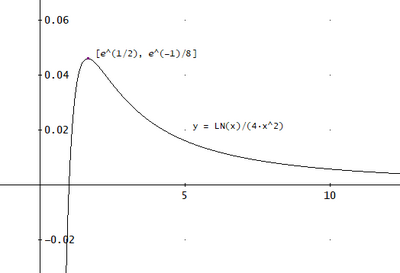
y = LN(x)/(4·x^2)
C.E. : x > 0
y' = (1 - 2·LN(x))/(4·x^3)
y' = 0:
1 - 2·LN(x) = 0----> x = e^(1/2)
y = LN(e^(1/2))/(4·(e^(1/2))^2)---> y = e^(-1)/8
[e^(1/2), e^(-1)/8] max rel ed assoluto
y''= (6·LN(x) - 5)/(4·x^4)
y''= (6·LN(e^(1/2)) - 5)/(4·(e^(1/2))^4)
y''= - e^(-2)/2 < 0