Spiegare gentilmente e argomentare i passaggi.
Spiegare gentilmente e argomentare i passaggi.

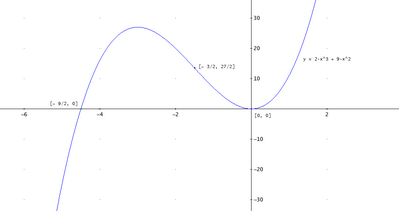
y = 2·x^3 + 9·x^2
Cubica: C.E. R illimitata sia inferiormente che superiormente
LIM(2·x^3 + 9·x^2) = -∞
x---> -∞
LIM(2·x^3 + 9·x^2) = +∞
x---> +∞
Intersezione con gli assi:
{y = 2·x^3 + 9·x^2
{y = 0
[x = 0 ∧ y = 0, x = - 9/2 ∧ y = 0]
[- 9/2, 0]
[0, 0]
Segno
2·x^3 + 9·x^2 > 0---> x ≠ 0 ∧ x > - 9/2
2·x^3 + 9·x^2 < 0---> x < - 9/2
y' = 6·x^2 + 18·x
y''= 12·x + 18
6·x^2 + 18·x > 0---> x < -3 ∨ x > 0
f(x) cresce
6·x^2 + 18·x < 0---> -3 < x < 0
f(x) decresce
6·x^2 + 18·x = 0---> x = -3 ∨ x = 0
x=-3 max relativo
x=0 min relativo
f''(-3)=12·(-3) + 18= -18 < 0 conferma di max rel
f''(0)=12·0 + 18= 18 >0 conferma di min relativo
Punto di flesso:
12·x + 18 = 0----> x = - 3/2
y = 2·(- 3/2)^3 + 9·(- 3/2)^2---> y = 27/2
[- 3/2, 27/2]