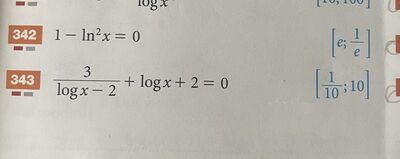


342) ln(x) = logaritmo in base e;
1 - ln^2(x) = 0;
x deve essere maggiore di 0; il logaritmo è definito per valori positivi di x.
I numeri negativi non hanno logaritmo.
ln(x) = t;
1 - t^2 = 0;
t^2 = 1;
t = +- radice(1);
t = + 1;
t = - 1;
ln(x) = 1;
x1 = e^1 = e;
ln(x) = - 1;
x2 = e^-1 = 1/e; soluzioni accettabili perché positive.
343) log(x) = logaritmo in base 10; x > 0;
log(x) = t;
denominatore t - 2 diverso da 0; t deve essere diverso da 2;
moltiplichiamo per il denominatore t - 2;
3/(t - 2) + (t + 2) = 0;
3 + (t + 2) * (t - 2) = 0; prodotto notevole (t + 2) * (t - 2) = t^2 - 4.
3 + t^2 - 4 = 0;
t^2 = 4 - 3;
t^2 = 1;
t = +- radice(1);
t = 1;
log x = 1;
x1 = 10^1 = 10;
t = - 1;
x2 = 10^-1 = 1/10.
Ciao @aurora-_

342
Posto x > 0 e ln x = y
1 - y^2 = 0
y^2 = 1
y = -1 V y = 1
ln x = -1 V ln x = 1
x = e^(-1) V x = e^1
x = 1/e V x = e
343
Posto x > 0 e log x - 2 =/= 0 => log x =/= 2 => x =/= 10^2 = 100
3/(y - 2) + y + 2 = 0
3 + (y - 2)(y + 2) = 0
y^2 - 4 + 3 = 0
y^2 = 1
y = -1 V y = 1
come prima
log x = -1 V log x = 1
x = 10^(-1) V x = 10^1
x = 1/10 V x = 10
entrambe accettabili.