Spiegare i ragionamenti, passaggi e argomentare.
Spiegare i ragionamenti, passaggi e argomentare.

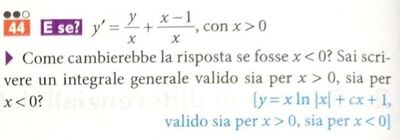
Riscriviamola, supponendo x ≠ 0, come
$ y' -\frac{1}{x}y = 1-\frac{1}{x} $ con x > 0
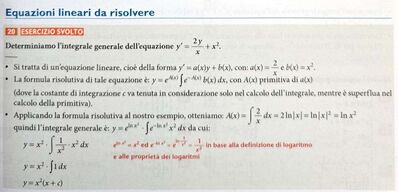
ODE di primo ordine a coefficienti variabili. Usiamo la formula del fattore integrante
$ y(x) = c \cdot e^{-A(x)} + e^{-A(x)} \int e^{A(t)} b(t) \, dt $
dove:
Calcoliamo A(x)
Applichiamo la formula
$ y(x) = c \cdot e^{ln(x)} + e^{ln(x)} \int e^{-ln(x)} \cdot (1 - \frac{1}{x}) \, dx $
$ y(x) = c \, x + x \int \frac{1}{x}(1 - \frac{1}{x}) \, dx $
$ y(x) = c \, x + x (ln x + \frac{1}{x} ) $
$ y(x) = c \, x + x \cdot ln x + 1 $
Nel caso di x < 0. Modifichiamo le formule a partire da
Calcoliamo A(x)
Applichiamo la formula
$ y(x) = c \cdot e^{ln(-x)} + e^{ln(-x)} \int e^{-ln(-x)} \cdot (1 - \frac{1}{x} ) \, dx $
$ y(x) = c \, (-x) - x \int \frac{1}{-x}(1 - \frac{1}{x}) \, dx $
essendo c reale può assumere anche valori negativi
$ y(x) = c \, x + x (ln |x| + \frac{1}{x} ) $
$ y(x) = c \, x + x \cdot ln |x| + 1 $