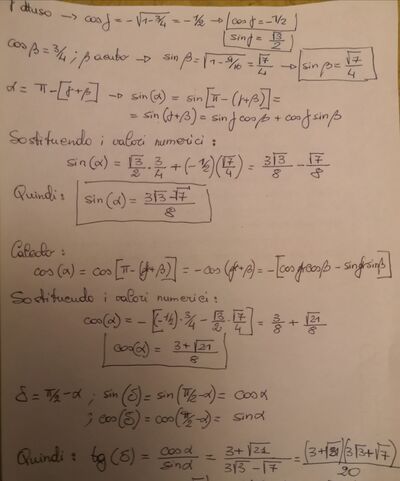

SIN(γ) = √3/2
angolo ottuso quindi 2° quadrante: γ = 2·pi/3 ----> COS(2·pi/3) = - 1/2
COS(β) = 3/4-----> SIN(β) = √(1 - (3/4)^2)-----> SIN(β) = √7/4
SIN(α) = SIN(β + γ) = SIN(pi - (β + γ))
SIN(α) = SIN(β)·COS(γ) + SIN(γ)·COS(β)
SIN(α) = √7/4·(- 1/2) + √3/2·(3/4)
SIN(α) = - (√7 - 3·√3)/8
SIN(α) = (3·√3 - √7)/8
δ = pi/2 - α
SIN(δ) = SIN(pi/2 - α)-----> SIN(δ) = COS(α)
COS(α) = √(1 - ((3·√3 - √7)/8)^2)-----> COS(α) = √21/8 + 3/8
COS(α) = (√21 + 3)/8
TAN(δ) = SIN(δ)/COS(δ)
SIN(δ) = (√21 + 3)/8 ; COS(δ) = SIN(α) = (3·√3 - √7)/8
quindi: TAN(δ) = (√21 + 3)/8/((3·√3 - √7)/8)
da cui: TAN(δ) = (3·√7 + 4·√3)/5

Per evitare troppi Copia/Incolla: (α, β, γ, δ) = (a, b, c, d)
---------------
Dal disegno si rilevano valori e relazioni.
* x = sin(a)
* y = tg(d)
* b = arccos(3/4)
* c = π - arcsin(√3/2) (perché "γ è ottuso")
* a = π - (b + c) = π - (arccos(3/4) + π - arcsin(√3/2)) = π/3 - arccos(3/4)
* d = π/2 - a = π/2 - (π/3 - arccos(3/4)) = π/6 + arccos(3/4)
---------------
Per rispondere ai due quesiti
* x = sin(a) = sin(π/3 - arccos(3/4))
* y = tg(d) = tg(π/6 + arccos(3/4))
occorrono e bastano poche delle identità di un formulario standard
* sin(x - y) = cos(y)*sin(x) - cos(x)*sin(y)
* tg(x + y) = (tg(x) + tg(y))/(1 - tg(x)*tg(y))
* cos(arccos(x)) = x
* sin(arccos(x)) = √(1 - x^2)
* tg(arccos(x)) = √(1 - x^2)/x
* sin(arccos(x)) = √(1 - x^2)
applicando le quali si ha
--------
* x = sin(a) = sin(π/3 - arccos(3/4)) =
= cos(arccos(3/4))*sin(π/3) - cos(π/3)*sin(arccos(3/4)) =
= (3/4)*sin(π/3) - cos(π/3)*√(1 - (3/4)^2) =
= (3*√3 - √7)/8
--------
* y = tg(d) = tg(π/6 + arccos(3/4)) =
= (tg(π/6) + tg(arccos(3/4)))/(1 - tg(π/6)*tg(arccos(3/4))) =
= (tg(π/6) + √(1 - x^2)/x)/(1 - tg(π/6)*√(1 - x^2)/x) =
= (4*x*√(1 - x^2) + √3)/(4*x^2 - 1)