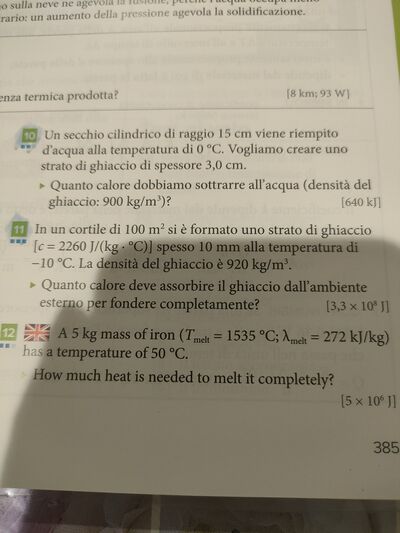
10 Un secchio cilindrico di raggio $15 \mathrm{~cm}$ viene riempito d'acqua alla temperatura di $0{ }^{\circ} \mathrm{C}$. Vogliamo creare uno strato di ghiaccio di spessore $3,0 \mathrm{~cm}$.
- Quanto calore dobbiamo sottrarre all'acqua (densità del ghiaccio: $900 \mathrm{~kg} / \mathrm{m}^3$ )?
[640 kJ]
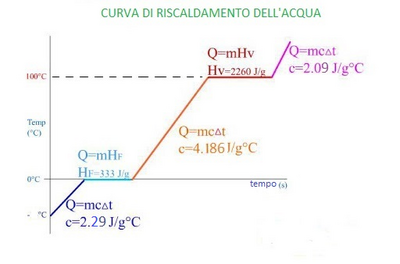
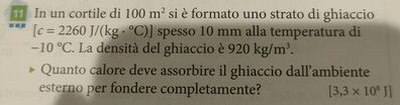
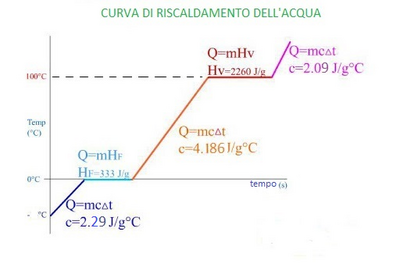
11 In un cortile di $100 \mathrm{~m}^2$ si è formato uno strato di ghiaccio $\left[c=2260 \mathrm{~J} /\left(\mathrm{kg} \cdot{ }^{\circ} \mathrm{C}\right)\right]$ spesso $10 \mathrm{~mm}$ alla temperatura di $-10^{\circ} \mathrm{C}$. La densità del ghiaccio è $920 \mathrm{~kg} / \mathrm{m}^3$.
- Quanto calore deve assorbire il ghiaccio dall'ambiente esterno per fondere completamente?
$\left[3,3 \times 10^8 \mathrm{~J}\right]$
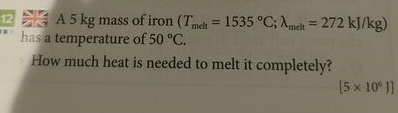
12 A $5 \mathrm{~kg}$ mass of iron $\left(T_{\text {melt }}=1535^{\circ} \mathrm{C} ; \lambda_{\text {melt }}=272 \mathrm{~kJ} / \mathrm{kg}\right)$ has a temperature of $50^{\circ} \mathrm{C}$.
How much heat is needed to melt it completely?
$$
\left[5 \times 10^6 \mathrm{~J}\right]
$$
Non riesco a capire sto due esercizi, qualcuno mi aiuta per favore?