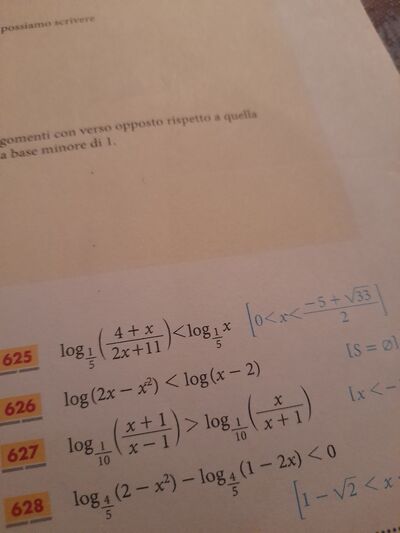
La disequazione
628) log(4/5, 2 - x^2) - log(4/5, 1 - 2*x) < 0
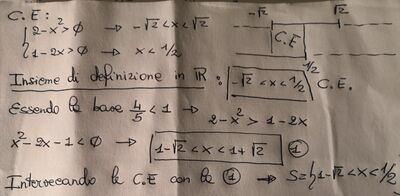
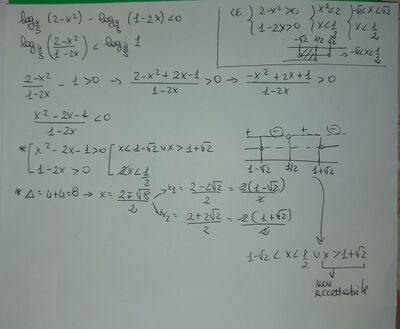
è definita per argomenti positivi
* (2 - x^2 > 0) & (1 - 2*x > 0) ≡ (- √2 < x < 1/2)
quindi, dopo qualche manipolazione semplificatoria,
* log(4/5, 2 - x^2) - log(4/5, 1 - 2*x) < 0 ≡
≡ log(5/4, 1 - 2*x) - log(5/4, 2 - x^2) < 0 ≡
≡ log(5/4, (1 - 2*x)/(2 - x^2)) < 0 ≡
≡ (5/4)^log(5/4, (1 - 2*x)/(2 - x^2)) < (5/4)^0 ≡
≡ (1 - 2*x)/(2 - x^2) < 1 ≡
≡ (2 - x^2 < 0) & (1 - 2*x > 2 - x^2) oppure (2 - x^2 > 0) & (1 - 2*x < 2 - x^2) ≡
≡ (2 - x^2 < 0) & (x^2 - 2*x - 1 > 0) oppure (2 - x^2 > 0) & (x^2 - 2*x - 1 < 0)
la si deve risolvere con tutt'e due le condizioni restrittive
* (- √2 < x < 1/2) & (2 - x^2 < 0) & (x^2 - 2*x - 1 > 0) oppure (- √2 < x < 1/2) & (2 - x^2 > 0) & (x^2 - 2*x - 1 < 0) ≡
≡ (insieme vuoto) & (x^2 - 2*x - 1 > 0) oppure (- √2 < x < 1/2) & (x^2 - 2*x - 1 < 0) ≡
≡ (- √2 < x < 1/2) & ((x - (1 - √2))*(x - (1 + √2)) < 0) ≡
≡ (1 - √2 < x < 1/2)
che è proprio il risultato atteso.