Spiegare gentilmente i ragionamenti, i passaggi e argomentare.
Spiegare gentilmente i ragionamenti, i passaggi e argomentare.

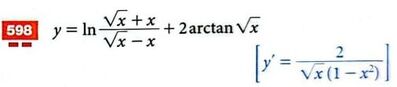
$D(ln\frac{\sqrt{x}+x}{\sqrt{x}-x} + 2arctan(\sqrt{x}) )= $
$ = D(ln\frac{\sqrt{x}+x}{\sqrt{x}-x}) + 2D(arctan(\sqrt{x}) )= $
$ = \frac{\sqrt{x}-x}{\sqrt{x}+x} D(\frac{\sqrt{x}+x}{\sqrt{x}-x}) + 2\frac{1}{1+x} D(\sqrt{x}) = $
$ = \frac{\sqrt{x}-x}{\sqrt{x}+x} \frac{1}{(1-\sqrt{x})^2 \sqrt{x}} + \frac{1}{(1+x) \sqrt{x}} = $
$ = \frac{\sqrt{x}(1-\sqrt{x})}{\sqrt{x}+x} \frac{1}{(1-\sqrt{x})^2 \sqrt{x}} + \frac{1}{(1+x)\sqrt{x}} = $
$ = \frac{1}{\sqrt{x}(\sqrt{x} + 1)(\sqrt{x} - 1) } + \frac{1}{(1+x)\sqrt{x}} = $
$ = \frac{1}{\sqrt{x}(1- x ) } + \frac{1}{(1+x)\sqrt{x}} = $
$ = \frac{1}{\sqrt{x}(1-x^2) } = $
$ = \frac{1+x+1-x}{\sqrt{x}(1-x^2) } = $
$ = \frac{2}{\sqrt{x}(1-x^2) } $