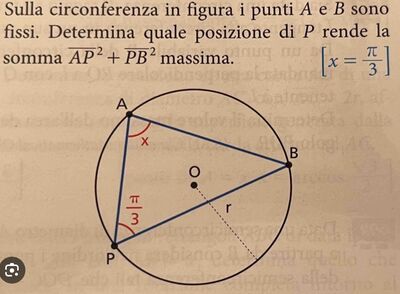


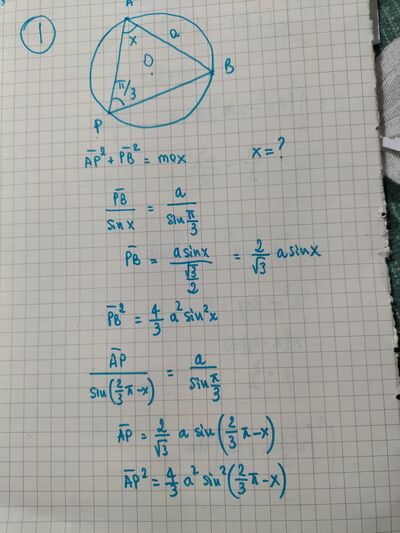
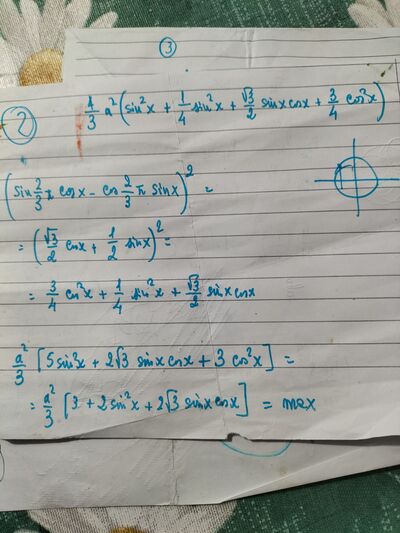
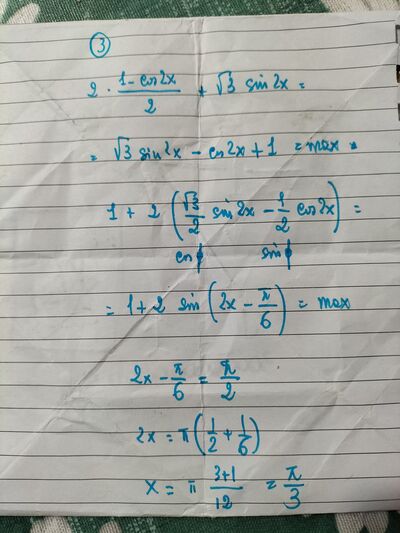
Si utilizza il teorema dei seni con alcune identità goniometriche.

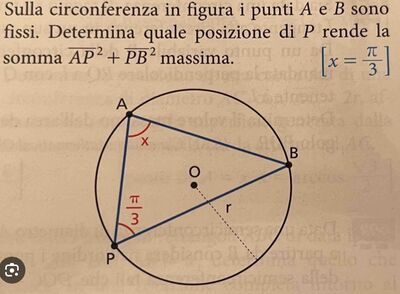
β = pi - (x + pi/3)---> β = 2·pi/3 - x
SIN(β) = SIN(2·pi/3 - x) = SIN(x + pi/3)
ΑΡ^2 = (2·r·SIN(x + pi/3))^2 (Th corda)
ΒΡ^2 = (2·r·SIN(x))^2 (Th corda)
Deve essere:
(2·r·SIN(x + pi/3))^2 + (2·r·SIN(x))^2=
=4·r^2·SIN(x + pi/3)^2 + 4·r^2·SIN(x)^2
Si tratta quindi di massimizzare la funzione:
y = SIN(x + pi/3)^2 + SIN(x)^2
avente derivate:
y' = 2·SIN(x + pi/3)·COS(x + pi/3) + 2·SIN(x)·COS(x)
y'' = 4·COS(x + pi/3)^2 + 4·COS(x)^2 - 4
C.N. per il problema richiesto: y' = 0
SIN(2·(x + pi/3)) = - SIN(2·x)
SIN(2·x + 2·pi/3) = - SIN(2·x)
posto 2·x = α
SIN(α + 2·pi/3) = - SIN(α)
SIN(α)·COS(2·pi/3) + SIN(2·pi/3)·COS(α) = - SIN(α)
√3·COS(α)/2 - SIN(α)/2 = - SIN(α)
√3·COS(α)/2 = - SIN(α)/2
posto COS(α) ≠ 0
TAN(α) = - √3----> α = 2·pi/3 = 2·x-----> x = pi/3
verifica sulla y'':
4·COS(pi/3 + pi/3)^2 + 4·COS(pi/3)^2 - 4 = -2 < 0 OK!!