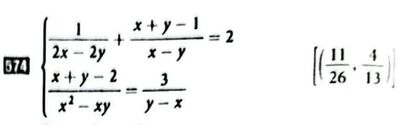
Spiegare gentilmente i ragionamenti e argomentare.
Spiegare gentilmente i ragionamenti e argomentare.

Portiamo alla forma intera le due equazioni
1^ equazione
1/(2·x - 2·y) + (x + y - 1)/(x - y) = 2
1/(2·(x - y)) + (x + y - 1)/(x - y) = 2
x - y ≠ 0----> x ≠ y
1 + 2·(x + y - 1) = 2·2·(x - y)
2·x + 2·y - 1 - (4·x - 4·y) = 0
- 2·x + 6·y - 1 = 0
2·x - 6·y = -1
-----------------------
2^ equazione
(x + y - 2)/(x^2 - x·y) = 3/(y - x)
(x + y - 2)/(x·(x - y)) + 3/(x - y) = 0
x·(x - y) ≠ 0-----> x ≠ y ∧ x ≠ 0
(x + y - 2) + 3·x = 0
4·x + y = 2
----------------------------
Sistema:
{2·x - 6·y = -1
{4·x + y = 2
risolvo per sostituzione:
y = 2 - 4·x
2·x - 6·(2 - 4·x) = -1
26·x - 12 = -1----> x = 11/26
y = 2 - 4·(11/26)----> y = 4/13
soluzione sistema:
[x = 11/26 ∧ y = 4/13]
compatibile con le condizioni di accettabilità (poste in grassetto sopra)

a. C.E. x ≠ y ∧ x ≠ 0
b. Risoluzione
$ \begin{cases} 1+2x+2y-2 = 4(x-y) \\ x+y-2 = -3x \end{cases} $
$ \begin{cases} 4x-12y = -2 \\ 4x+y = 2 \end{cases} $
per riduzione. (2°-1° → 1°)
$ \begin{cases} 13y = 4 \\ 4x+y = 2 \end{cases} $
dalla prima $ y = \frac{4}{13} $
dalla seconda $ 4x = \frac{22}{13} \; ⇒ \; x=\frac{11}{26} $
L'unica soluzione del sistema è $(\frac{11}{26}, \frac{4}{13})$