Potreste darmi una mano con il n. 72?
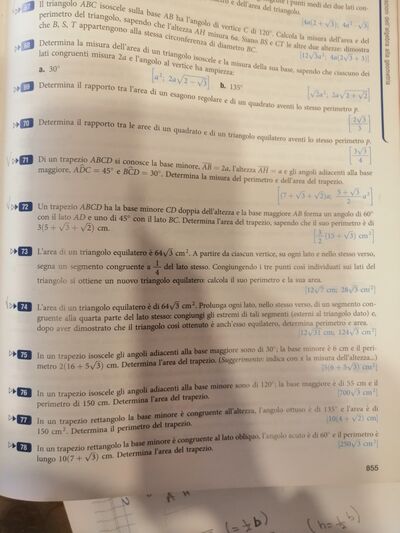
Potreste darmi una mano con il n. 72?

AD = y
x = √3/2·y----> y = 2·√3·x/3
ΒC = z
z = √2·x
ΑΒ = 2·x + x + y/2
ΑΒ = 2·x + x + 2·√3·x/3/2
ΑΒ = x·(√3/3 + 3)
perimetro=
ΑΒ + CD + y + z = x·(√3/3 + 3) + 2·x + 2·√3·x/3 + √2·x
perimetro= x·(√3 + √2 + 5)
per confronto con i dati:
x = 3 cm
Α = 1/2·(x·(√3/3 + 3) + 2·x)·x
Α = 1/2·(3·(√3/3 + 3) + 2·3)·3
Α = 3/2·(√3 + 15) cm^2

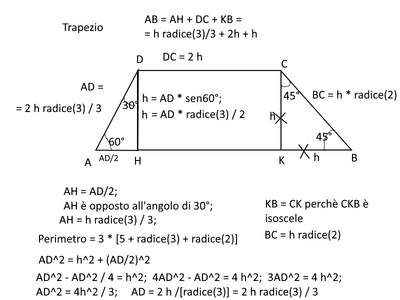
AD = 2h radice(3)/3;
AB = h radice(3)/3 + 2h + h = h radice(3) / 3 + 3h; (base maggiore);
BC = h radice(2);
DC = 2h;
Tutti i lati dipendono da h; h è l'incognita da trovare;
Perimetro = AD + AB + BC + DC;
Perimetro = 2h radice(3)/3 + [h radice(3)/3 + 3h] + h radice(2) + 2h ;
2h radice(3)/3 + h radice(3)/3 + 3h + h radice(2) + 2h = 3[5 + radice(3) + radice(2)] ;
h * [2 radice(3)/ 3 + radice(3) / 3 + 3 + radice(2) + 2] = 3[5 + radice(3) + radice(2)] ;
h = 3[5 + radice(3) + radice(2)] / [ 3 radice(3)/ 3 + 5 + radice(2)] ;
h = 3[5 + radice(3) + radice(2)] /[radice(3) + 5 + radice(2)];
h = 3 cm;
CD = 3 * 2 = 6 cm;
AB = 3 * radice(3)/3 + 2 * 3 + 3 = radice(3) + 9 ;
Area = (AB + CD) * h / 2;
Area = [radice(3) + 9 + 6] * 3 / 2 = [radice(3) + 15] * 3 /2.
Ciao @cettas
Non avevo finito l'esercizio, ho controllato, va bene.
Ciao.