COMPLETA in modo che ABC sia un angolo retto.
269
A (2;5), B(1;1), C(_; -1).
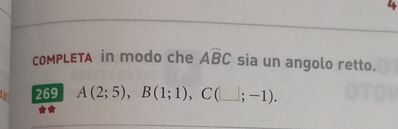
COMPLETA in modo che ABC sia un angolo retto.
269
A (2;5), B(1;1), C(_; -1).

Il coefficiente angolare della retta passante per A, B è:
m_AB= 4
La retta BC deve avere coefficiente angolare m1 antireciproco.
m1= 2/(1-x) = - 1/4
Quindi:
1/(1 - x) = 1/8
Da cui si ricava: x= 9

@stefanopescetto come hai fatto a ricavare 9? perché a me viene 8
Dalle coordinate dei vertici
* A(2, 5), B(1, 1), C(k, 1)
si calcolano le lunghezze dei lati
* a = |BC| = √((k - 1)^2)
* b = |AC| = √(k^2 - 4*k + 20)
* c = |AB| = √17
---------------
Per essere rettangolo in B deve valere
* a^2 = b^2 + c^2 ≡
≡ (k - 1)^2 = (k^2 - 4*k + 20) + 17 ≡
≡ (k - 1)^2 - (k^2 - 4*k + 20) - 17 = 0 ≡
≡ 2*(k - 18) = 0 ≡
≡ k = 18
---------------
Vedi al link
http://www.wolframalpha.com/input?key=&i=triangle%282%2C5%29%281%2C1%29%2818%2C1%29
i paragrafi
* Visual representation
* Triangle shape
* Properties: interior angles