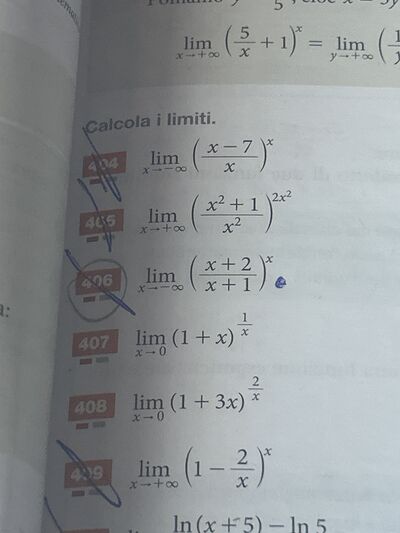


LIM(((x + 2)/(x + 1))^x = e
x---> -∞
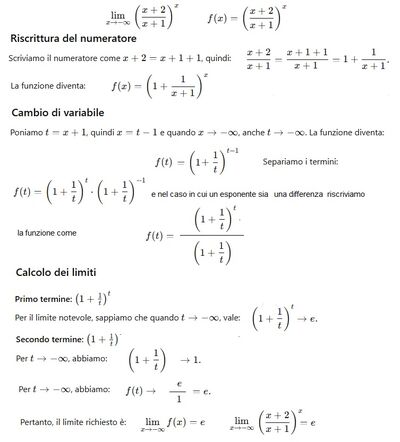
Basta notare che:
((x + 2)/(x + 1))^x = (1/(x + 1) + 1)^x
quindi coincide con la definizione di e


limite notevole:
lim_(x → +∞) di (1 + 1/x)^x = e
(x + 2) /(x + 1) = [(x + 1) + 1] /(x + 1) =
= [(x + 1) / (x + 1)] + 1 / (x + 1) =
= 1 + 1 / (x + 1);
chiamiamo x + 1 = t;
x = t - 1; la funzione diventa:
(1 + 1 / t)^(t - 1) = (1 + 1/t)^t / (1 + 1/t)^1
limite per t che tende a +∞ (1 + 1/t)^t = e; (numeratore);
limite per t che tende a +∞ (1 + 1/t) = 1 + 0 = 1; (denominatore);
lim_(t → +∞) di (1 + 1 / t)^(t - 1) = e / 1 = e.
lim_(t → +∞) di [(x + 2) /(x + 1)] = e
Ciao @angela12