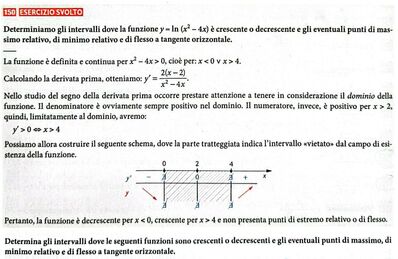

Spiegare e argomentare gentilmente i passaggi.
Spiegare e argomentare gentilmente i passaggi.

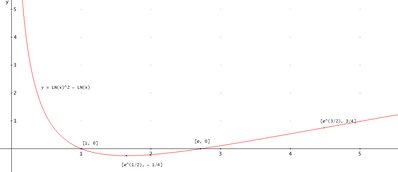
y = LN(x)^2 - LN(x)
C.E. x > 0
Non possiede intersezioni con asse delle y
{y = LN(x)^2 - LN(x)
{y = 0
Risolvo: [x = 1 ∧ y = 0, x = e ∧ y = 0]
Condizioni agli estremi del C.E.
LIM(LN(x)^2 - LN(x)) = +∞
x---> 0+
LIM(LN(x)^2 - LN(x)) = +∞
x---> +∞
Segno funzione:
LN(x)^2 - LN(x) > 0---> 0 < x < 1 ∨ x > e
LN(x)^2 - LN(x) < 0---> 1 < x < e
Derivate:
y'= 2·LN(x)/x - 1/x
y''= 3/x^2 - 2·LN(x)/x^2
-----------------------------
2·LN(x)/x - 1/x > 0 se x > e^(1/2)
f(x) cresce
2·LN(x)/x - 1/x < 0 se 0 < x < e^(1/2)
f(x) decresce
2·LN(x)/x - 1/x = 0 se x = e^(1/2)
y = LN(e^(1/2))^2 - LN(e^(1/2)) = - 1/4
[e^(1/2), - 1/4] min relativo ed assoluto
------------------------------
3/x^2 - 2·LN(x)/x^2 > 0 se
0 < x < e^(3/2)
3/x^2 - 2·LN(x)/x^2 < 0 se
x > e^(3/2)
3/x^2 - 2·LN(x)/x^2 = 0 se
x = e^(3/2) per cui si ha flesso discendente