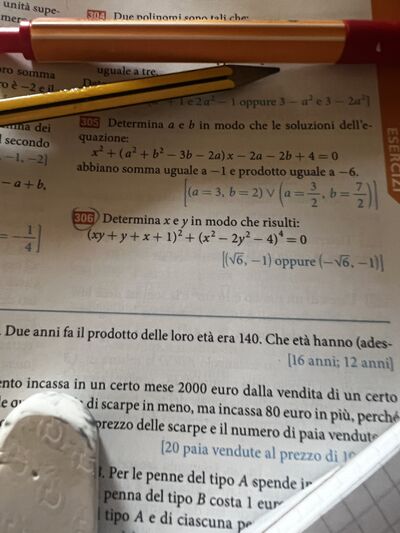
Determina x e y in modo che risulti:
(xy +y + x+ 1)^2 + (x^2 -2y^2 -4)^4=0
Determina x e y in modo che risulti:
(xy +y + x+ 1)^2 + (x^2 -2y^2 -4)^4=0

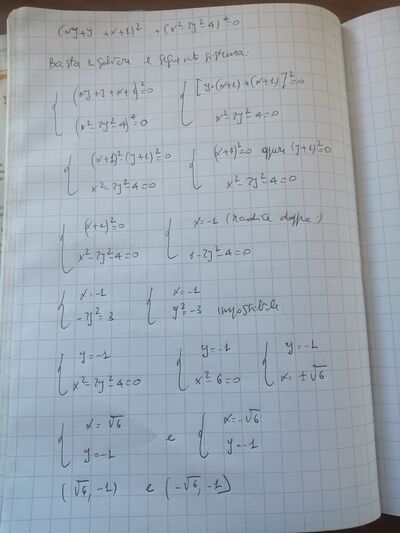
Una somma di quadrati può essere nulla solo se le basi sono tutte individualmente nulle.
Questo ti riporta al sistema
{ xy + y + x + 1 = 0
{ x^2 - 2y^2 - 4 = 0
{ y(x + 1) + (x + 1) = 0
{ x^2 - 2y^2 = 4
{ (x + 1) (y + 1) = 0
{ x^2 - 2y^2 = 4
allora x = -1 e 1 - 2y^2 = 4 => 2y^2 = -3 => no soluzioni
oppure y = -1 e x^2 - 2 = 4 => x^2 = 6
(-rad6, -1) V (rad6, -1)


Si tratta di calcolare le intersezioni reali fra un'iperbole e due rette ortogonali parallele agli assi coordinati.
* (x*y + y + x + 1)^2 + (x^2 - 2*y^2 - 4)^4 = 0 ≡
≡ (x*y + y + x + 1 = 0)^2 & (x^2 - 2*y^2 - 4 = 0)^4 ≡
≡ ((x + 1)*(y + 1) = 0) & ((x/2)^2 - (y/√2)^2 = 1) ≡
≡ ((x = - 1) oppure (y = - 1)) & ((x/2)^2 - (y/√2)^2 = 1) ≡
≡ (x = - 1) & ((x/2)^2 - (y/√2)^2 = 1) oppure (y = - 1) & ((x/2)^2 - (y/√2)^2 = 1) ≡
≡ (x = - 1) & ((- 1/2)^2 - (y/√2)^2 = 1) oppure (y = - 1) & ((x/2)^2 - (- 1/√2)^2 = 1) ≡
≡ (x = - 1) & (y^2 = - 3/2) oppure (y = - 1) & (x = ± √6) ≡
≡ (nessun punto reale) oppure (x = - √6) & (y = - 1) oppure (x = √6) & (y = - 1) ≡
≡ (x = - √6) & (y = - 1) oppure (x = √6) & (y = - 1)