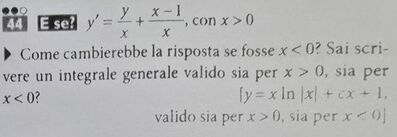
Spiegare gentilmente i ragionamenti, i passaggi e argomentare.
Spiegare gentilmente i ragionamenti, i passaggi e argomentare.

$ y' -\frac{1}{x}y = 1-\frac{1}{x} $
dove:
per cui se x > 0
$ y(x) = ce^{ln(x)} + e^{ln(x)} \int e^{-ln(t)} (-1+\frac{1}{t} ) \, dt $
$ y(x) = c \cdot x + x \int \frac{1}{t} (-1+\frac{1}{t} ) \, dt $
$ y(x) = c \cdot x + x \int \frac{1}{t} +\frac{1}{t^2} ) \, dt $
$ y(x) = c \cdot x + x [ln(x) +\frac{1}{x} ] $
$ y(x) = c \cdot x + x (ln(x) +\frac{1}{x}) $
$ y(x) = c \cdot x + x \, ln(x) + 1 $
se, invece x < 0
$ y(x) = ce^{ln(-x)} + e^{ln(-x)} \int e^{-ln(-t)} (-1+\frac{1}{t} ) \, dt $
$ y(x) = c \cdot (-x) - x \int -\frac{1}{t} (-1+\frac{1}{t} ) \, dt $ Il prodotto per -1 passa all'interno di c
$ y(x) = c \cdot x + x \int \frac{1}{t} - \frac{1}{t^2} ) \, dt $
$ y(x) = c \cdot x + x [ln(-x) +\frac{1}{x} ] $
$ y(x) = c \cdot x + x (ln|x| +\frac{1}{x}) $
$ y(x) = c \cdot x + x \, ln|x| + 1 $
questa soluzione include anche la soluzione per x > 0