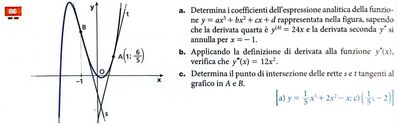
Spiegare gentilmente i ragionamenti, i passaggi e argomentare.
Spiegare gentilmente i ragionamenti, i passaggi e argomentare.

y = a·x^5 + b·x^2 + c·x + d
y' = 5·a·x^4 + 2·b·x + c
y'' = 20·a·x^3 + 2·b
y''' = 60·a·x^2
y'''' = 120·a·x
Deve essere:
120·a·x = 24·x
che fornisce: a = 1/5 ∨ x = 0
y = 1/5·x^5 + b·x^2 + c·x + d
La derivata seconda si annulla per x = -1:
20·(1/5)·(-1)^3 + 2·b = 0
b = 2
y = 1/5·x^5 + 2·x^2 + c·x + d
passa per l'origine: d=0
6/5 = 1/5·1^5 + 2·1^2 + c·1----> c = -1
(passa per [1, 6/5] )
La funzione polinomiale ha equazione:
y = 1/5·x^5 + 2·x^2 - x
----------------------------------------
La derivata seconda è:
y'' = 4·x^3 + 4 = f(x)
calcoliamo y''' in base alla definizione:
f(x+h) = 4·(x + h)^3 + 4
Il rapporto incrementale vale:
(4·(x + h)^3 + 4 - (4·x^3 + 4))/h=
=((4·x^3 + 12·h·x^2 + 12·h^2·x + 4·h^3) + 4 - (4·x^3 + 4))/h=
=(12·h·x^2 + 12·h^2·x + 4·h^3)/h=
=4·h·(3·x^2 + 3·h·x + h^2)/h
quindi:
y'''=
LIM(4·h·(3·x^2 + 3·h·x + h^2)/h) =12·x^2
h---> 0
-----------------------------------------
Coordinate del punto B
y = 1/5·x^5 + 2·x^2 - x per x = -1:
y = 1/5·(-1)^5 + 2·(-1)^2 - (-1)----> y = 14/5
B [-1,14/5]
retta tangente in B:
y' = x^4 + 4·x - 1 per x=-1:
(-1)^4 + 4·(-1) - 1 = -4
y - 14/5 = - 4·(x + 1)---> y = - 4·x - 6/5
retta tangente in A [1, 6/5]
verifico l'ordinata:
y = 1/5·1^5 + 2·1^2 - 1---> y = 6/5 OK!!
f'(1)=1^4 + 4·1 - 1= 4
y - 6/5 = 4·(x - 1)----> y = 4·x - 14/5
Metto a sistema le due rette:
{y = - 4·x - 6/5
{y = 4·x - 14/5
Risolvo ed ottengo: [x = 1/5 ∧ y = -2]