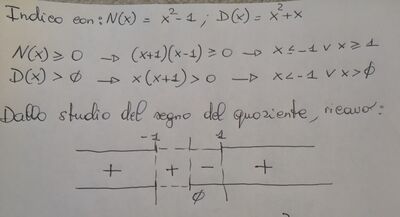



Segno N(x):
++++[-1]-------------------[+1]++++++>x
Segno D(x) :
++++(-1)--------(0)+++++++++++++>x
Segno rapporto:
++++(-1)++++(0)--------[+1]++++++>x
Soluzione disequazione:
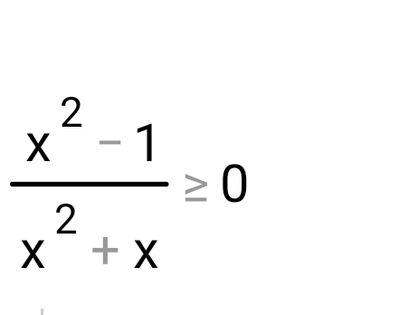
(x^2 - 1)/(x^2 + x) ≥ 0-------> [(x ≠ -1 ∧ x < 0) ∨ x ≥ 1]

* (f(x) = (x^2 - 1)/(x^2 + x) >= 0) & (x^2 + x != 0) ≡
≡ (x < - 1) oppure (- 1 < x < 0) oppure (x >= 1)
in quanto
* per x in {- 1, 0}, f(x) è indefinita
* per x = 1, f(x) = 0
esclusi questi tre valori si ha
* f(x) = (x^2 - 1)/(x^2 + x) > 0 ≡
≡ (x^2 - 1)*(x^2 + x) > 0 ≡
≡ (x - 1)*x*(x + 1)^2 > 0 ≡
≡ (x - 1)*x > 0 ≡
≡ (x < 0) oppure (x > 1)