Spiegare gentilmente i passaggi e argomentare.
Spiegare gentilmente i passaggi e argomentare.

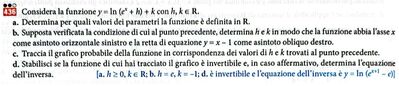
y = LN(e^x + h) + k
C.E.
e^x + h > 0
essendo e^x>0 sempre , la f(x) per essere definita in tutto R deve essere h ≥ 0.
Asintoto sinistro y=0
Deve essere:
LIM(LN(e^x + h) + k) = LN(h) + k = 0
x----> -∞
Asintoto obliquo destro y= x-1
m
LIM((LN(e^x + h) + k)/x) =1
x----> +∞
q
LIM(LN(e^x + h) + k - x) = k
x---> +∞
Quindi confronto:
y = x - 1
y = x + k
k = -1
LN(h) + k = 0---> LN(h) - 1 = 0
h = e
Intersezione con asse y:
{y = LN(e^x + e) - 1
{x = 0
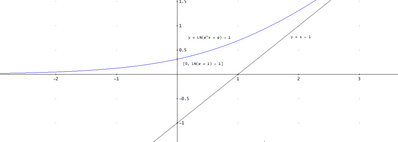
[x = 0 ∧ y = LN(e + 1) - 1]
[x = 0 ∧ y = 0.3132616875]
Grafico:
Funzione inversa:
x = LN(e^y + e) - 1
risolvo:
y = LN(e^x - 1) + 1