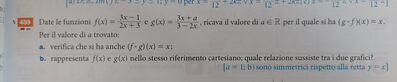
Considera $f(x)=2 x-1$ e $g(x)=\frac{1}{2 x+2}$.
a. Per quali $x$ si ha $(f \circ g)(x)=(g \circ f)(x)$ ?
b. Risolvi l'equazione $(f \circ g)(x)+f(x)=-1$.
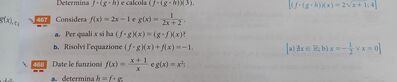
Considera $f(x)=2 x-1$ e $g(x)=\frac{1}{2 x+2}$.
a. Per quali $x$ si ha $(f \circ g)(x)=(g \circ f)(x)$ ?
b. Risolvi l'equazione $(f \circ g)(x)+f(x)=-1$.

Le due funzioni composte sono
g(f(x)) = 1/[2(2x-1) + 2] = 1/(4x)
f(g(x)) = 2/(2x+2) - 1 = 1/(x+1) - 1 = -x/(x+1)
1/(4x) = -x/(x+1)
con x =/= -1, x=/= 0
-4x^2 = x + 1
4x^2 + x + 1 = 0
il delta é negativo => non ci sono radici
-x/(x+1) + 2x - 1 = -1
2x - x/(x+1) = 0
x[ 2 - 1/(x+1) ] = 0
x = 0 V x+1 = 1/2 => x = -1/2

L'inversa di (ax + b)/(cx + d)
si ottiene ponendo
(ax + b)/(cx + d) = y
ax + b = cxy + dy
ax - cxy = dy - b
(a - cy) x = dy - b
x = (dy - b)/(-cy + a)
ed é allora
y = (dx - b)/(-cx + a)
nel nostro caso (3x + 1)/(-2x + 3)
che per essere uguale a g richiede a = 1
Il resto é facile. Sostituisci l'espressione trovata e svolgi i calcoli