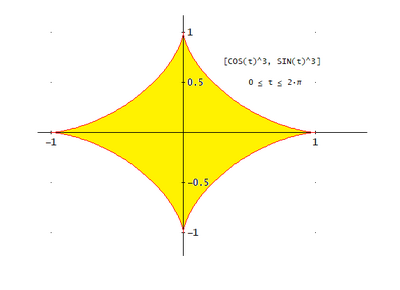

Ricordando che
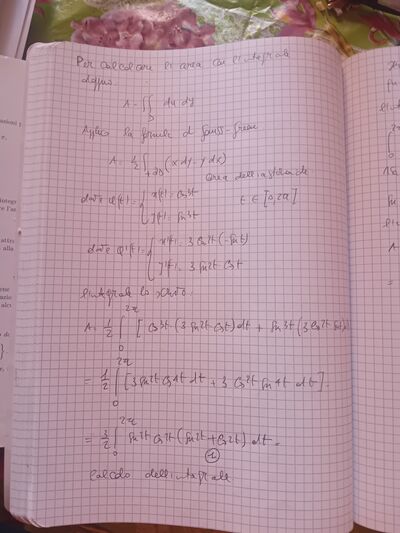
S[D] = 1/2 S_[d+D] (x dy - y dx) per una conseguenza delle formule di Gauss - Green nel piano
https://www.youmath.it/lezioni/analisi-due/varie/2289-teorema-di-gauss-green.html
si procederà al calcolo dell'integrale a mano secondo la parametrizzazione indicata.

{x = COS(t)^3
{y = SIN(t)^3
con 0 ≤ t ≤ 2·pi
x' = - 3·SIN(t)·COS(t)^2
y' = 3·SIN(t)^2·COS(t)
Calcolo:
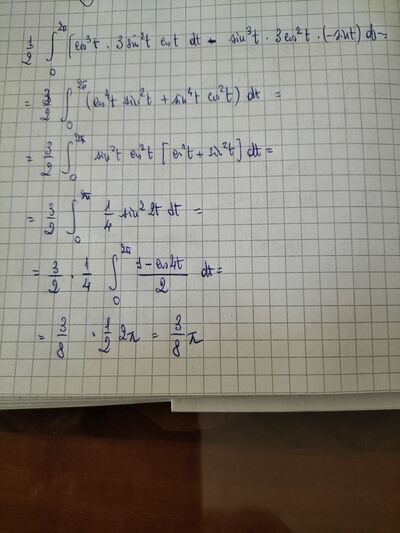
1/2·(x·y' - y·x') =
=1/2·(COS(t)^3·(3·SIN(t)^2·COS(t)) - SIN(t)^3·(- 3·SIN(t)·COS(t)^2)) =
=1/2·(3·SIN(t)^2·COS(t)^2)
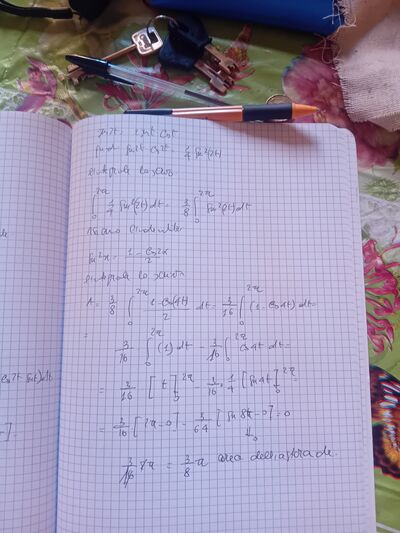
Integro quindi il risultato dell'integrale:
∫(1/2·(3·SIN(t)^2·COS(t)^2))dt = - 3·SIN(t)·COS(t)^3/8 + 3·SIN(t)·COS(t)/16 + 3·t/16
fra t = 0 e t = 2·pi
per ottenere l'area A=
=- 3·SIN(2·pi)·COS(2·pi)^3/8 + 3·SIN(2·pi)·COS(2·pi)/16 + 3·(2·pi)/16+
-(- 3·SIN(0)·COS(0)^3/8 + 3·SIN(0)·COS(0)/16 + 3·0/16)) =
=3·pi/8 - 0 = 3·pi/8