Buongiorno,
ho queste due proprorzioni da risolvere ma non mi vengono i risultati, non credo di aver capito bene, qualcuno può spiegarmele? Grazie

Buongiorno,
ho queste due proprorzioni da risolvere ma non mi vengono i risultati, non credo di aver capito bene, qualcuno può spiegarmele? Grazie

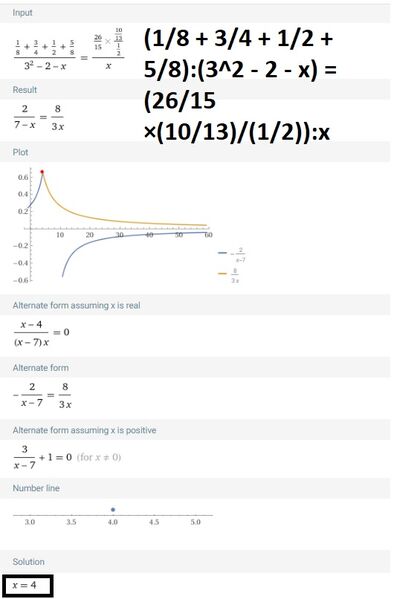
(1/8+3/4+1/2+5/8)/(3²-2-x)=(26/15*10/13/(1/2))/x
(1/8+6/8+4/8+5/8)/(7-x)=(2/3*2/1/(1/2))/x
2/(7-x)=4/3(1/2)/x
1/(7-x)=2/3(1/2):x
1/(7-x)=4/(3x) ---> 3x/4 =7-x
28 = 7x ---> x =4



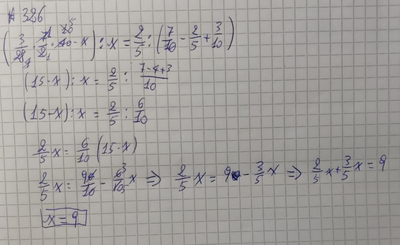
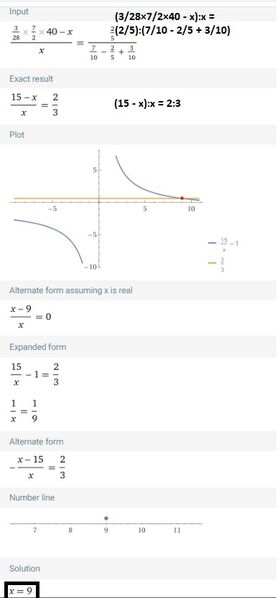
(120/8-x) : x = 2/5 10
(15-x) : x = 2/5 : (6/10)
si fa il prodotto in croce
(15-x)*6/10 = 2x/5
9-6x/10 = 2x/5
9 = 2x/5+6x/10
9 = (4x+6x)/10
9 = 10x/10
x = 9

 143353
punti
143353
punti
 Genius III

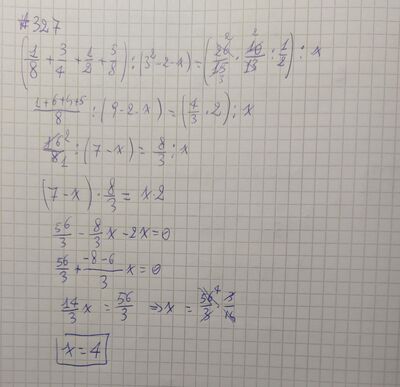
(1+6+4+5)/8 : (7-x) = (20/15*2) : x
2 : (7-x) = 8/3 : x
si fa il prodotto in croce
2x = 56/3-8x/3
2x+8x/3 = 56/3
14x/3 = 56/3
14x = 56
x = 56/14
x = 4
143353
punti
Genius III
326)
$\small \left(\dfrac{3}{28}·\dfrac{7}{2}·40-x\right) : x = \dfrac{2}{5} : \left(\dfrac{7}{10}-\dfrac{2}{5}+\dfrac{3}{10}\right)$
$\small \left(\dfrac{3}{\cancel{28}_4}·\dfrac{\cancel7^1}{\cancel2_1}·\cancel{40}^{20}-x\right) : x = \dfrac{2}{5} : \left(\dfrac{7}{10}-\dfrac{2}{5}+\dfrac{3}{10}\right)$
$\small \left(\dfrac{3}{4}·\dfrac{1}{1}·20-x\right) : x = \dfrac{2}{5} : \left(\dfrac{7-4+3}{10}\right)$
$\small \left(\dfrac{3}{\cancel4_1}·\cancel{20}^5-x\right) : x = \dfrac{2}{5} : \dfrac{6}{10}$
$\small \left(3·5-x\right) : x = \dfrac{2}{5} : \dfrac{\cancel6^3}{\cancel{10}_5}$
$\small \left(15-x\right) : x = \dfrac{2}{5} : \dfrac{3}{5}$
applica il metodo del comporre:
$\small \left(15-x+x\right) : x = \left(\dfrac{2}{5}+\dfrac{3}{5}\right) : \dfrac{3}{5}$
$\small \left(15-\cancel{x}+\cancel{x}\right) : x = \dfrac{\cancel5^1}{\cancel5_1} : \dfrac{3}{5}$
$\small 15 : x = 1 : \dfrac{3}{5}$
$\small x = \cancel{15}^3×\dfrac{3}{\cancel5_1} : 1$
$\small x = 3×3 = 9$

327)
$\small \left(\dfrac{1}{8}+\dfrac{3}{4}+\dfrac{1}{2}+\dfrac{5}{8}\right) : \left(3^2-2-x\right) = \left(\dfrac{26}{15}·\dfrac{10}{13} : \dfrac{1}{2}\right) : x$
$\small \left(\dfrac{1+6+4+5}{8}\right) : \left(9-2-x\right) = \left(\dfrac{\cancel{26}^2}{\cancel{15}_3}·\dfrac{\cancel{10}^2}{\cancel{13}_1}·2\right) : x$
$\small \dfrac{16}{8} : \left(7-x\right) = \left(\dfrac{2}{3}·2·2\right) : x$
$\small \dfrac{\cancel{16}^2}{\cancel8_1} : \left(7-x\right) = \left(\dfrac{2}{3}·4\right) : x$
$\small 2 : \left(7-x\right) = \dfrac{8}{3} : x$
$\small x = \dfrac{\dfrac{8}{3}\left(7-x\right)}{2}$
moltiplica tutto per 2:
$\small 2x = \dfrac{8}{3}\left(7-x\right)$
$\small 2x = \dfrac{56}{3}-\dfrac{8}{3}x$
moltiplica tutto per 3:
$\small 6x = 56-8x$
$\small 6x+8x = 56$
$\small 14x = 56$
dividi per 14 ambo le parti per isolare l'incognita:
$\small \dfrac{\cancel{14}x}{\cancel{14}} = \dfrac{56}{14}$
$\small x = 4$