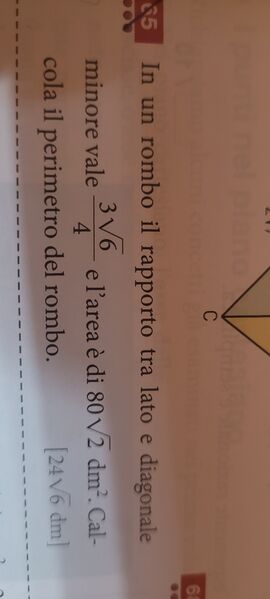


Foto dritta!!
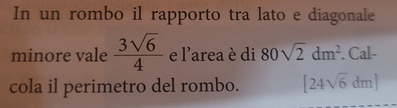
{l = √((d/2)^2 + (Δ/2)^2) = lato rombo
d= diagonale minore (in dm)
Δ = diagonale maggiore (in dm)
{l/d = 3·√6/4
{1/2·d·Δ = 80·√2 (in dm^2)
d = 160·√2/Δ
l = √((160·√2/Δ/2)^2 + (Δ/2)^2)
l/(160·√2/Δ) = 3·√6/4
l = 240·√3/Δ
240·√3/Δ = √((160·√2/Δ/2)^2 + (Δ/2)^2)
240·√3/Δ = √(12800/Δ^2 + Δ^2/4)
Risolvo:
Δ = 20·√2 dm
l = 240·√3/(20·√2)-----> l = 6·√6 dm
perimetro rombo=4·6·√6 = 24·√6 dm

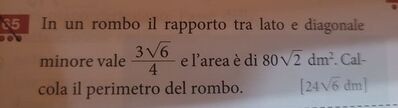
=============================================================
Visto il rapporto poni il lato e la diagonale minore come segue:
lato $\small l= (3\sqrt6)x;$
diagonale minore $\small d= 4x;$
quindi:
diagonale maggiore utilizzando il teorema di Pitagora:
$\small D= 2×\sqrt{\left(3\sqrt6·x\right)^2-\left(\dfrac{4x}{2}\right)^2}$
$\small D= 2×\sqrt{9·6x^2-(2x)^2}$
$\small D=2×\sqrt{54x^2-4x^2}$
$\small D=2×\sqrt{50x^2}$
$\small D= 2×5\sqrt2x = 10\sqrt2x;$
conoscendo l'area del rombo, calcola:
$\small \dfrac{D×d}{2} = A$
$\small \dfrac{10\sqrt2x×4x}{2} = 80\sqrt2$
$\small 10\sqrt2x×4x = 160\sqrt2$
$\small 40\cancel{\sqrt2}x^2 = 160\cancel{\sqrt2}$
$\small 40x^2 = 160$
$\small \dfrac{\cancel{40}x^2}{\cancel{40}} = \dfrac{\cancel{160}^4}{\cancel{40}_1}$
$\small x^2 = 4$
$\small \sqrt{x^2} = \sqrt4$
$\small x= 2$
per cui:
lato $\small l= (3\sqrt6)x = 3\sqrt6×2 = 6\sqrt6\,dm;$
perimetro $\small 4×l = 4×6\sqrt6 = 24\sqrt6\,dm.$

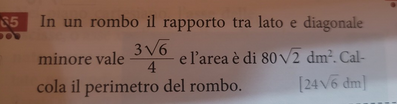
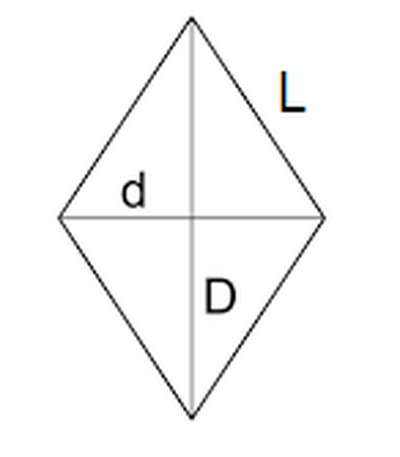
L/d = 3√6 /4
4L = 3d√6
d = 4L/(3√6)
d/2 = 2L/(3√6)
D^2/4 = L^2-(d/2)^2 = L^2- 4L^2/54
D^2 = 4L^2(1- 4/54)
D = 2L√(1- 4/54) = 2L√50/54
2A = d*D
160√2 = (8L^2/3)√50/(54*6)
60√2 = L^2√50/(54*6)
3600*2 = L^4*50/324
144*324 = L^4
L^2 = 12√(9*6^2) = 12*18 = 4*3*9*2 dm^2
L = 6√6 dm
perimetro 2p = 4*6√6 = 24√6 dm

 143353
punti
143353
punti
 Genius III