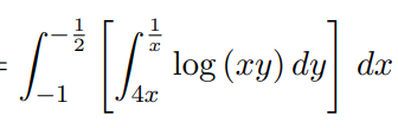


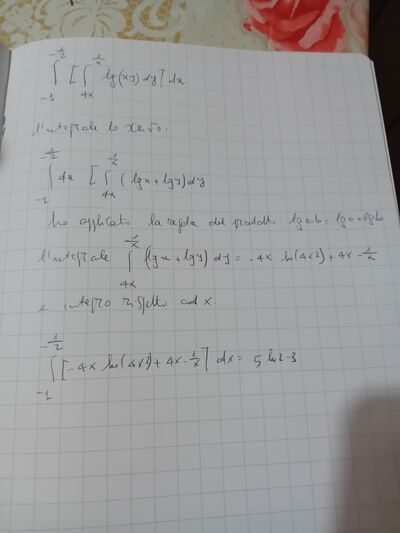

S_[-1, -1/2] S_[4x, 1/x] (ln x + ln y) dy dx
S 1* ln y dy = y ln y - S y*1/y dy = y ln y - y + C
S_[-1, -1/2] [ y ln x + y ln y - y ]_[4x, 1/x] dx =
= S_[-1, -1/2] [ 1/x ln x + 1/x ln 1/x - 1/x - 4x ln x - 4x ln 4x + 4x ] dx =
= S_[-1, -1/2] [ -1/x - 4x ln 4x^2 + 4x ] dx =
= S_[-1/2, -1] (-4x + 1/x + 8x ln 2x) dx
2 S 2x ln 2x d(2x)
S t ln t dt = t^2/2 ln t - S t^2/2 * 1/t dt = t^2/2 ln t - t^2/4 + C
diventa
2 [ 4x^2/2 ln |2x| - 4x^2/4 ] = 4x^2 ln |2x| - 2 x^2
4 x^2 ln |2x| - 2x^2 - 2x^2 + ln |x|=
= 4x^2 ln |2x| - 4x^2 + ln |x|
per x = -1
4 ln 2 - 4 + 0 = 4 ln 2 - 4
per x = -1/2
1 ln 1 - 1 + ln 1/2 = - 1 - ln 2
e la differenza é
5 ln 2 - 3
Ora so che é esatto perché Wolfram si trova

e ha ragione perché Wolfram é d'accordo. Rileggi il testo, ho corretto gli errori.
Com'è che solo io trovo una consistente parte immaginaria?
Dov'è la consegna d'intendere "ln(|x|)" al posto di "ln(x)"?
Assumerla se non è esplicitamente scritta comporta bocciatura per "ipotesi semplificativa" (almeno, così era quando facevo esami io!).
-----------------------------
* ln(x*y) = ln(x) + ln(y)
---------------
* ∫ ln(x*y)*dy = ∫ ln(x)*dy + ∫ ln(y)*dy = y*ln(x) + y*(ln(y) - 1) = y*(ln(x) + ln(y) - 1) + C
* ∫ [y = 4*x, 1/x] ln(x*y)*dy = ((1/x)*(ln(x) + ln(1/x) - 1)) - (4*x*(ln(x) + ln(4*x) - 1)) =
= (- 1/x) - (x*(8*ln(2*x) - 4)) =
= (4*x^2 - 1)/x - 8*x*ln(2*x)
---------------
* ∫ ((4*x^2 - 1)/x - 8*x*ln(2*x))*dx =
= ∫ ((4*x^2 - 1)/x)*dx - ∫ (8*x*ln(2*x))*dx =
= 2*x^2 - ln(x) - 2*(2*ln(2*x) - 1)*x^2 + C =
= 4*(1 - ln(2*x))*x^2 - ln(x) + C
* ∫ [x = - 1, - 1/2] ((4*x^2 - 1)/x - 8*x*ln(2*x))*dx =
= (4*(1 - ln(2*(- 1/2)))*(- 1/2)^2 - ln(- 1/2)) - (4*(1 - ln(2*(- 1)))*(- 1)^2 - ln(- 1)) =
= (1 - ln(- 1) - ln(- 1/2)) - (4*(1 - ln(- 2)) - ln(- 1)) =
= (1 - (0 + i*π) - (ln(1/2) + i*π)) - (4*(1 - (ln(2) + i*π)) - (0 + i*π)) =
= (1 + ln(2) - i*2*π) - (4*(1 - ln(2)) - i*5*π) =
= 5*ln(2) - 3 + i*3*π