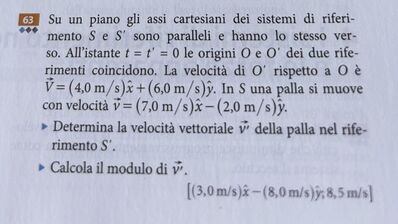
Su un piano gli assi cartesiani dei sistemi di riferimento $S$ e $S^{\prime}$ sono paralleli e hanno lo stesso verso. All'istante $t=t^{\prime}=0$ le origini $\mathrm{O}$ e $\mathrm{O}^{\prime}$ dei due riferimenti coincidono. La velocità di $\mathrm{O}^{\prime}$ rispetto a $\mathrm{O}$ è $\vec{V}=(4,0 \mathrm{~m} / \mathrm{s}) \hat{x}+(6,0 \mathrm{~m} / \mathrm{s}) \hat{y}$. In $S$ una palla si muove con velocità $\vec{v}=(7,0 \mathrm{~m} / \mathrm{s}) \hat{x}-(2,0 \mathrm{~m} / \mathrm{s}) \hat{y}$.
Determina la velocità vettoriale $\vec{v}^{\prime}$ della palla nel riferimento $S^{\prime}$.
Calcola il modulo di $\overrightarrow{v^{\prime}}$.
$$
[(3,0 \mathrm{~m} / \mathrm{s}) \hat{x}-(8,0 \mathrm{~m} / \mathrm{s}) \hat{y} ; 8,5 \mathrm{~m} / \mathrm{s}]
$$