Un aiuto
Un aiuto

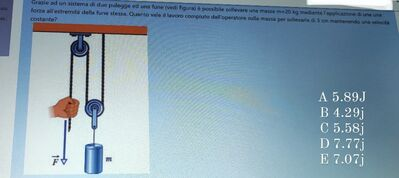
E = m*g*Δh = 20*9,806*3/100 = 5,884 joule
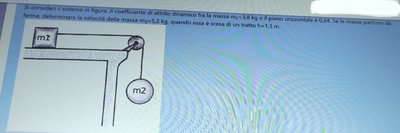
accelerazione a = g(m1-m2*0,24)/(m1+m2) = 9,806*(5,2-3,8*0,24)/(5,2+3,8) = 4,6720 m/sec^2
V = √2ah = √2*4,6720*1,3 = 3,485 m/sec
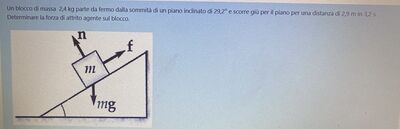
Δh = 2,9*sen (29,2°) = 1,415m
Vte = √2*g*Δh = √2*9,806*1,415 = 5,268 m/sec
Vr = 2L/t = 5,8/3,2 = 1,813 m/sec
energia persa Ep = 2,4/2(5,268^2-1,813^2) = 29,36 joule = Fa*L
forza di attrito Fa = Ep/L = 29,36/2,9 = 10,1 N

 143353
punti
143353
punti
 Genius III
Vedi, per averlo occorre chiederlo in modo comprensibile.

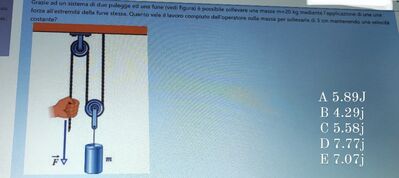
a) A perchè tale è , in assenza di attriti, la -deltaU = Ui -Uf = m*g*h - 0 = mgh = L { = F*2*h}
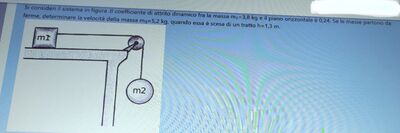
b) P2 = m2*g
Fattr = mu*m1*g
Ftot = P2 - Fattr = g(m2 - m1*mu)
L= Ftot*h = K = m2*v²/2 ---> v = sqrt(2* g(m2 - m1*mu)*h /m2)
{o anche atot = Ftot/(m2) ---> s=h= 1.3 m ---> 2*s*atot = v² ---> v =sqrt(2*s*atot) = sqrt(2*h*g(m2 - m1*mu)/(m2)) }
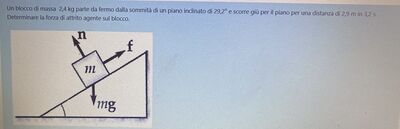
c) s = 2.9 m = a*t^2/2 ---> a = 2s/t² = g - aattr --> aattr =g - 2s/t²
Fattr = m*aattr
mu = Fattr/(m*g*sen29.2°) = aattr /(g*sen29.2°)
... controlla!