

PB = (1 - 1/4) AB = 3/4 L
PQ = PB/2 rad(3) = 3/8 L rad(3)
essendo poi h = L/2 rad(3)
PQ = 3/4 * L/2 rad(3) = 3/4 h = 3/4 * 3 cm = 2.25 cm

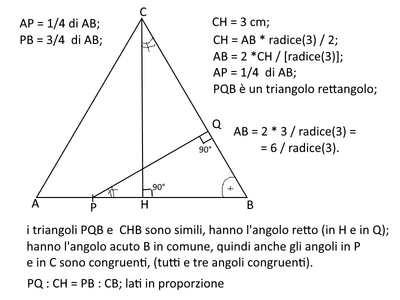
AB = 2 * CH /radice(3) = 2 * 3 / radice(3) = 6 * radice(3) / 3;
AB = 2 radice(3) cm
AP = AB / 4 = 2 radice(3) / 4 = radice(3) / 2;
PB = AB - AP = 3/4 di AB;
PB = 3 * AP = 3 * radice(3) / 2;
lati in proporzione nei triangoli simili PQB e CHB;
(PB e BC sono le ipotenuse dei triangoli, PQ e CH sono i rispettivi cateti) :
PQ : CH = PB : BC;
CH = 3 cm;
BC = AB = 2 radice(3);
PQ : 3 = [3 * radice(3) / 2] : [2 radice(3)];
PQ = 3 * [3 * radice(3) / 2] : [2 radice(3)]; radice(3) si semplifica;
PQ = 9 / 4 = 2,25 cm.
Ciao @muta

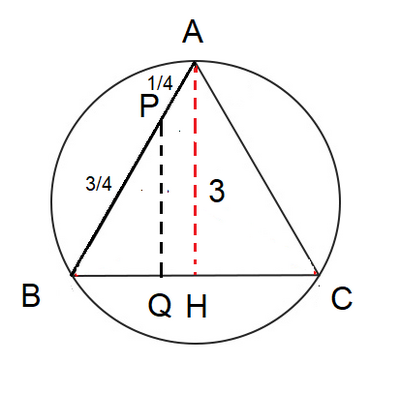
PQ / (1-1/4) = h / 1
PQ = 3h/4 = 9/4 = 2,25 cm

 143360
punti
143360
punti
 Genius III

====================================================
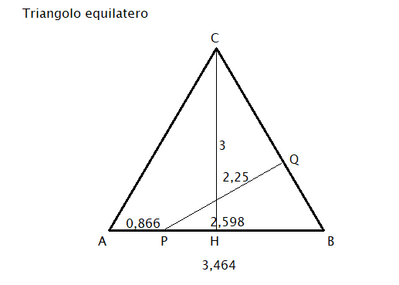
Altezza $\small CH= 3\,cm;$
ciascun lato $\small AB=BC=AC= \dfrac{3}{\sqrt{\dfrac{3}{4}}} = 2\sqrt3\,cm\quad(\approx{3,464}\,cm);$
segmento $\small AP= \dfrac{1}{4}×2\sqrt3 = \dfrac{\sqrt3}{2}\,cm\quad(\approx{0,866}\,cm);$
segmento $\small PB= 2\sqrt3 -\dfrac{\sqrt3}{2} = \dfrac{3\sqrt3}{2}\,cm\quad(\approx{2,598}\,cm);$
vedendo che i triangoli rettangoli CHB e PBQ sono simili applica la seguente proporzione:
$\small CH : BC = PQ : PB$
$\small 3 : 2\sqrt3 = PQ : \dfrac{3\sqrt3}{2}$
$\small PQ = \dfrac{3×\dfrac{3\sqrt3}{2}}{2\sqrt3}$
$\small PQ= \dfrac{\dfrac{9\sqrt3}{2}}{2\sqrt3}$
$\small PQ=\dfrac{9\cancel{\sqrt3}}{2}×\dfrac{1}{2\cancel{\sqrt3}}$
$\small PQ=\dfrac{9}{2}×\dfrac{1}{2}$
$\small PQ= \dfrac{9}{4}= 2,25\,cm.$
Oppure:
$\small CH : BC = PQ : PB$
$\small 3 : 3,464 = PQ : 2,598$
$\small PQ= \dfrac{3×2,598}{3,464} = 2,25\,cm.$