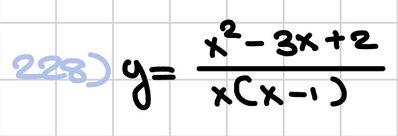


f(x) = x^2 - 3·x + 2---> f' = 2·x - 3
g(x)= x·(x - 1)----> g' = 2·x - 1
y=f/g-----> y' = (f'·g - f·g')/g^2
y' =
=((2·x - 3)·(x·(x - 1)) - (x^2 - 3·x + 2)·(2·x - 1))/(x·(x - 1))^2=
=((2·x - 3)·(x^2 - x) - (x^2 - 3·x + 2)·(2·x - 1))/(x·(x - 1))^2=
=((2·x^3 - 5·x^2 + 3·x) - (2·x^3 - 7·x^2 + 7·x - 2))/(x·(x - 1))^2=
=(2·x^2 - 4·x + 2)/(x·(x - 1))^2=
=2·(x - 1)^2/(x·(x - 1))^2
posto x ≠ 1
y' = 2/x^2
-------------------------------
Altrimenti:
y = (x^2 - 3·x + 2)/(x·(x - 1))
y = (x - 1)·(x - 2)/(x·(x - 1)) posto x ≠ 1:
y = (x - 2)/x
y = 1 - 2/x------> y' = 2/x^2