Notifiche
Cancella tutti

[Risolto] Aiuto gogniometria


0

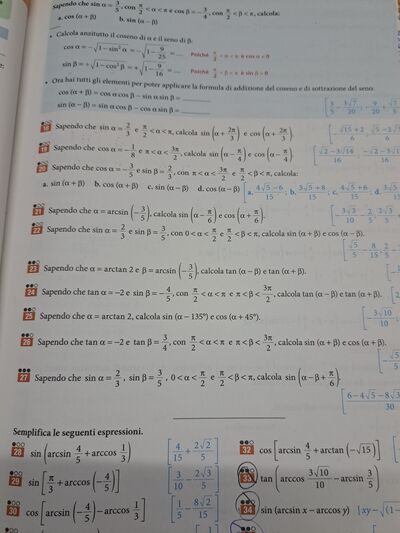
Sapendo che $\sin \alpha=\frac{2}{3}$ e $\sin \beta=\frac{3}{5}$, con $0<\alpha<\frac{\pi}{2}$ e $\frac{\pi}{2}<\beta<\pi$, calcola $\sin (\alpha+\beta)$ e $\cos (\alpha-\beta)$.

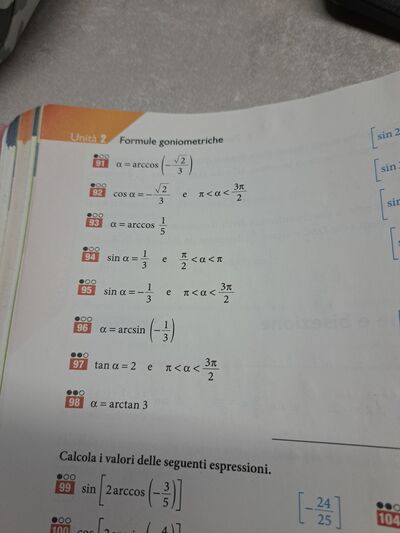
Non so come risolvere 3 esercizi il 91, 92 e 22 potete spiegarmi anche come si risolvono per piacere
16996316494472068990370883434584
16996317637421598878959966114723


Autore
2 Risposte


3

91) l'immagine della funzione arccos (x) è [0;pi]. Quindi:

cos(x) = - radice (2)/3

sin(x) = +radice (1-2/9) = (1/3)* radice (7)

Determino 

sin(2x)=2*sin(x)*cos(x)

cos(2x)=cos²x - sin²x

92)

Terzo quadrante: la funzione sin(x) restituisce un valore negativo 

sin x = - (1/3)*radice (7)

Determino 

sin(2x)=2*sin(x)*cos(x)

cos(2x)=cos²x - sin²x


1
image

SIN(α) = 2/3 ; SIN(β) = 3/5

con:

0 < α < pi/2: angolo del 1° quadrante SENO e COSENO positivi

pi/2 < β < pi: angolo del 2° quadrante SENO>0 e COSENO<0

COS(α) = √(1 - (2/3)^2)----> COS(α) = √5/3

COS(β) = - √(1 - (3/5)^2)---> COS(β) = - 4/5

SIN(α + β) = SIN(α)·COS(β) + SIN(β)·COS(α)

SIN(α + β) = 2/3·(- 4/5) + 3/5·(√5/3)

SIN(α + β) = √5/5 - 8/15

COS(α - β) = COS(α)·COS(β) + SIN(α)·SIN(β)

COS(α - β) = √5/3·(- 4/5) + 2/3·(3/5)

COS(α - β) = 2/5 - 4·√5/15


Risposta