

f.e.m. = - ∆Φ / ∆t; legge di Faraday - Lenz:
flusso di B:
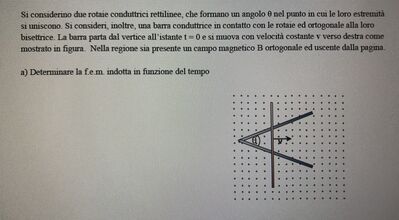
Φ = B * (Area triangolo); Area variabile, aumenta nel tempo; B costante, uscente dal foglio.
Area attraversata dalle linee del campo B:
A = base * h / 2;
h = v * (t - to);
(b/2) / h = tan(ϑ/2);
b/2 = h * tan(ϑ/2);
b = 2 h tan (ϑ/2);
b = 2 [v (t - to)] tan (ϑ/2);
∆(Area) = 2 v (t - to) tan (ϑ/2) * v (t - to) / 2;
∆(Area) = v^2 (t - to)^2 tan(ϑ/2);
to = 0 s;
f.e.m. = - B * (∆ Area) / (∆t);
f.e.m. = - B * [v^2 (t - to)^2 tan(ϑ/2) ] / (t - to),
f.e.m. = - [B v^2 t^2 tan(ϑ/2) ] / t = - B v^2 t tan(ϑ/2); forza elettromotrice indotta.
è uscente e l'area aumenta, la corrente indotta circolerà in senso orario per generare
Quando l'area diventa costante, il flusso non varia, allora f.e.m. = 0 Volt.
Poniamo la rotaia è lunga L;
la base massima si ha quando la barra conduttrice arriva all'estremità ;
cos(ϑ/2) = hmax / L;
cos((ϑ/2) = v (t max) / L;
t max = L * cos((ϑ/2) / v;
L = h max /cos((ϑ/2)
la base diventa all'estremo :
b = 2 L sen(ϑ/2);
b = 2 sen(ϑ/2) * [ v t /cos((ϑ/2)] ;
b = 2 (h max) tan(ϑ/2).
b = 2 * v * (t max) * tan(ϑ/2).
@inga ciao.