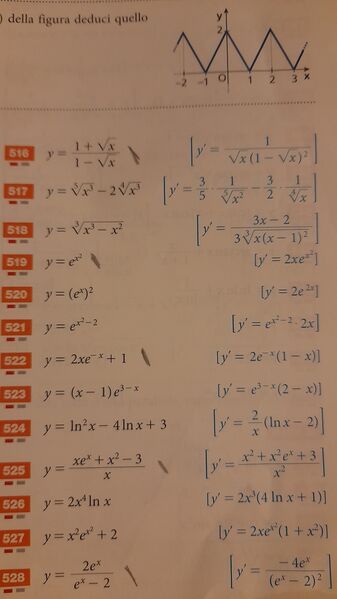


$ y(x) = \frac{1+\sqrt{x}}{1-\sqrt{x}}$
$ y'(x) = \frac{ \frac{1}{2\sqrt{x}}(1-\sqrt{x})+ \frac{1}{2\sqrt{x}}(1+\sqrt{x})}{(1-\sqrt{x})^2} $
$ y'(x) = \frac{ \frac{1}{2\sqrt{x}}(1-\sqrt{x}+1+\sqrt{x})}{(1-\sqrt{x})^2} $
$ y'(x) = \frac{ \frac{1}{2\sqrt{x}}2}{(1-\sqrt{x})^2} $
$ y'(x) = \frac{1}{\sqrt{x}(1-\sqrt{x})^2} $

518)
y = (x^3 - x^2)^(1/3);
y'(x) = 1/3 * [(x^3 - x^2) ^(1/3 - 1)] * (3x^2 - 2x) =
= [(x^3 - x^2) ^(- 2/3)] * (3x^2 - 2x) / 3 =
= 1 /[radicecubica(x^3 - x^2)^2] * (3x^2 - 2x) / 3 =
= (3x^2 - 2x) / {3 radicecubica[(x^3 - x^2)^2]} =
= x (3x - 2) /{3 radicecubica[(x^2 (x - 1) )^2] } =
= x (3x - 2) /{3 radicecubica[x^4 (x - 1)^2]} =
= x (3x - 2) /{3x radicecubica[x (x - 1)^2]} =
= (3x - 2) /{3 radicecubica[x (x - 1)^2]}.
Ciao @ris