
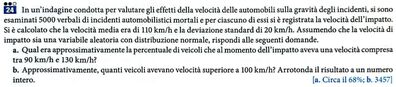
Spiegare gentilmente i ragionamenti e argomentare.
Spiegare gentilmente i ragionamenti e argomentare.

f(x) = 1/√(2·pi·σ^2)·e^(- (x - μ)^2/(2·σ^2))
∫(1/√(2·pi·σ^2)·e^(- (x - μ)^2/(2·σ^2))) dx =
=ERF(√2·(x - μ)/(2·σ))/2
μ = 110 km/h
σ = 20 km/h
ERF(√2·(x - 110)/(2·20))/2
P(90 km/h ≤ x ≤ 130 km/h)
ERF(√2·(130 - 110)/(2·20))/2 = ERF(√2/2)/2
ERF(√2·(90 - 110)/(2·20))/2 = - ERF(√2/2)/2
Quindi:
ERF(√2/2)/2 - (- ERF(√2/2)/2) = ERF(√2/2) = 0.6826894921
arrotondando 68%
-------------------------------
ERF(√2·(x - 110)/(2·20))/2
da valutare da x= 100 km/h ad x → +∞
LIM(ERF(√2·(x - 110)/(2·20))/2) = 1/2
x---> +∞
ERF(√2·(100 - 110)/(2·20))/2 = - ERF(√2/4)/2
quindi:
1/2 - (- ERF(√2/4)/2) = ERF(√2/4)/2 + 1/2 = 0.6914624612
per cui:
0.6914624612·5000 = 3457.312305
cioè 3457 autoveicoli coinvolti

a) Pr [ 90 <= V <= 130 ] = Pr [ 90 <= N(110,20^2) <= 130 ] =
= normcdf((130 - 110)/20) - normcdf((90 - 110)/20) =
= mormcdf(1) - normcdf(-1) = 0.6827 circa
b) 5000 * Pr [ V > 100 ] = 5000 * (1 - normcdf((100-110)/20)) =
= 3457
Usando la correzione di continuità risulterebbe invece
a') normcdf((130.5-110)/20) - normcdf((89.5-110)/20) = 0.6946
b') 5000 * (1 - normcdf((100.5-110)/20)) = 3413