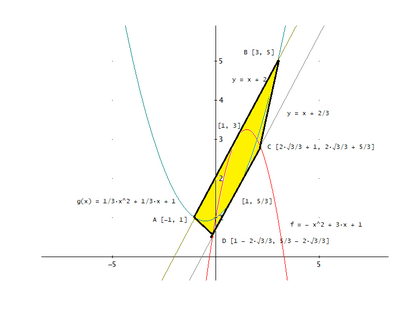
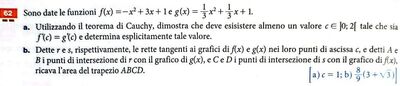
Spiegare gentilmente i passaggi e argomentare.
Spiegare gentilmente i passaggi e argomentare.

f(x) = - x^2 + 3·x + 1
g(x) = 1/3·x^2 + 1/3·x + 1
0 < x < 2
f(2) = - 2^2 + 3·2 + 1=3
f(0)= - 0^2 + 3·0 + 1= 1
3 - 1 = 2
g(2) = 1/3·2^2 + 1/3·2 + 1= 3
g(0) = 1/3·0^2 + 1/3·0 + 1= 1
3 - 1 = 2
f'(x) = 3 - 2·x
g'(x) = 2·x/3 + 1/3
Th di Cauchy:
(3 - 2·x)/(2·x/3 + 1/3) = 2/2
3·(3 - 2·x) = 2·x + 1----> x = 1
------------------------------------------
f(1) = - 1^2 + 3·1 + 1----> f = 3
[1, 3]
g(1) = 1/3·1^2 + 1/3·1 + 1-----> g = 5/3
[1, 5/3]
1^retta tangente:
y - 3 = 1·(x - 1)---> y = x + 2
2^ retta tangente:
y - 5/3 = 1·(x - 1)---> y = x + 2/3
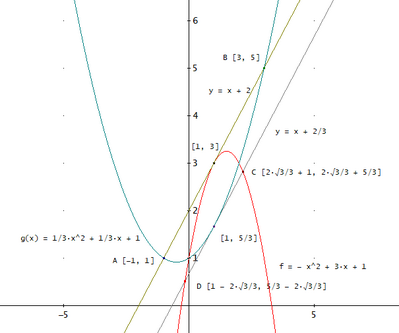
{y = x + 2
{y = 1/3·x^2 + 1/3·x + 1
risolvo:
[x = -1 ∧ y = 1, x = 3 ∧ y = 5]
A [-1, 1]
B [3, 5]
{y = x + 2/3
{y = - x^2 + 3·x + 1
Risolvo:
[x = 2·√3/3 + 1 ∧ y = 2·√3/3 + 5/3, x = 1 - 2·√3/3 ∧ y = 5/3 - 2·√3/3]
C [2·√3/3 + 1, 2·√3/3 + 5/3]
D [1 - 2·√3/3, 5/3 - 2·√3/3]
A [-1, 1]
Determino area:
Α = 1/2·ABS((- 1·5 + 3·(2·√3/3 + 5/3) + (2·√3/3 + 1)·(5/3 - 2·√3/3) + (1 - 2·√3/3)·1) - (- 1·(5/3 - 2·√3/3) + (1 - 2·√3/3)·(2·√3/3 + 5/3) + (2·√3/3 + 1)·5 + 3·1))
Α = 8·(√3 + 3)/9