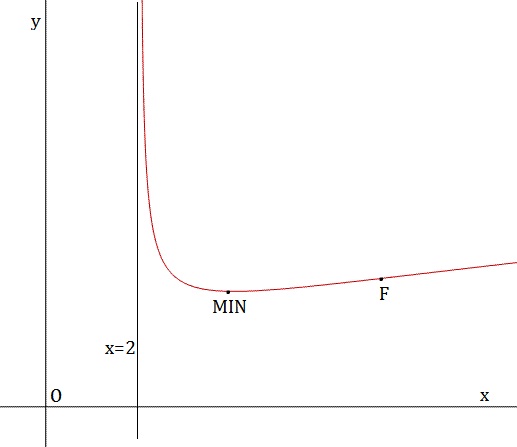
Studiare la seguente funzione:
$$
f(x)=\frac{x}{\sqrt{x-2}}
$$
1) Dominio:
$$
D=(2 ;+\infty)
$$
2) Simmetrie:
$$
\begin{gathered}
f(-x)=\frac{-x}{\sqrt{-x-2}} \
f(-x) \neq f(x) \
f(-x) \neq-f(x)
\end{gathered}
$$
$f(x)$ non è ne pari ne dispari.
3) Intersezioni con gli assi:
$$ \left\{\begin{array}{c} f(x)=0 \\ x=0 \end{array} \rightarrow x=0 \notin D\right. $$4) Segno: $$ f(x)>0 \forall x \in D $$
5) Limiti: $$ \lim {x \rightarrow 2^{+}} f(x)=+\infty $$ $x=2$ è asintoto verticale per $f(x)$. $$ \begin{gathered} \lim {x \rightarrow+\infty} f(x)=+\infty \ \lim _{x \rightarrow+\infty} \frac{f(x)}{x}=0 \end{gathered} $$
Non ci sono asintoti obliqui.
6) Derivate:
Calcoliamo la derivata prima:
$$
\begin{gathered}
f^{\prime}(x)=\left[\sqrt{x-2}-\frac{x}{2 \sqrt{x-2}}\right] \frac{1}{x-2} \
f^{\prime}(x)=\frac{2(x-2)-x}{2(x-2) \sqrt{x-2}}
\end{gathered}
$$
$$
f^{\prime}(x)=\frac{x-4}{2(x-2)^{\frac{3}{2}}}
$$
Studiamone il segno:
$$
f^{\prime}(x) \geq 0 \rightarrow x \geq 4
$$
Otteniamo quindi un minimo per
$$
x_{M I N}=4
$$
Derivata seconda:
$$
\begin{gathered}
f \prime \prime(x)=\frac{2(x-2)^{\frac{3}{2}}-(x-4) \cdot 2 \cdot \frac{3}{2}(x-2)^{\frac{1}{2}}}{4(x-2)^3} \
f \prime \prime(x)=\frac{\sqrt{x-2}(8-x)}{4(x-2)^3} \
f \prime \prime(x) \geq 0 \rightarrow 8-x \geq 0 \
f \prime \prime(x) \geq 0 \rightarrow x \leq 8
\end{gathered}
$$
Otteniamo un punto di flesso:
$$
x_F=8
$$