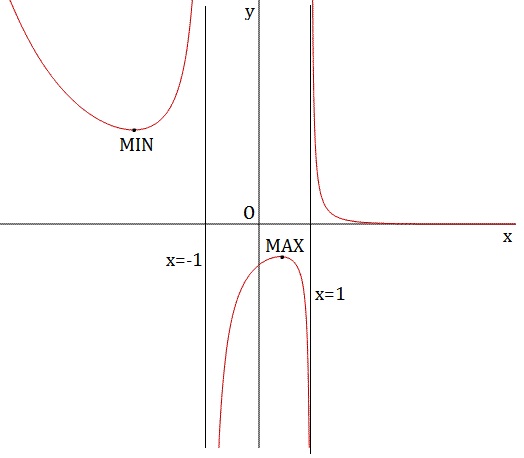
Studiare la seguente funzione:
$$
f(x)=\frac{e^{1-x}}{x^2-1}
$$
1) Dominio:
$$
D=\mathbb{R}-{ \pm 1}
$$
2) Simmetrie:
$$
\begin{gathered}
f(-x)=\frac{e^{1-(-x)}}{(-x)^2-1}=\frac{e^{1+x}}{x^2-1} \
\
f(-x) \neq f(x) \
f(-x) \neq-f(x)
\end{gathered}
$$
$f(x)$ non è ne pari ne dispari.
3) Intersezioni con gli assi:
$$\left\{\begin{array}{c}x=0 \\ f(x)=-e\end{array} \rightarrow(0 ;-e) \in f(x)\right.$$
$$\left\{\begin{array}{c}y=0 \\ e^{(1-x)}=0\end{array} \rightarrow \varnothing\right.$$
4) Segno:
$$\begin{gathered}f(x)>0 \rightarrow x^2-1>0 \\ \left\{\begin{array}{l}f(x)>0 \rightarrow x<-1 \vee x>1 \\ f(x)<0 \rightarrow x>-1 \wedge x<1\end{array}\right.\end{gathered}$$
5) Limiti:
$$\lim {x \rightarrow \pm 1} f(x)=\infty $$
$x=-1$ e $x=1$ sono quindi asintoti verticali, per la funzione data.
$$\lim {x \rightarrow+\infty} f(x)=0$$
$y=0$ è quindi un asintoto orizzontale.
$$\lim {x \rightarrow-\infty} f(x)=+\infty $$
Inoltre
$$ \lim {x \rightarrow-\infty} \frac{f(x)}{x}=\infty$$
ne consegue che non ci sono asintoti obliqui.
6) Derivate:
Calcoliamo la derivata prima:
$$
\begin{gathered}
f^{\prime}(x)=\frac{-e^{1-x}\left(x^2-1\right)-e^{1-x}(2 x)}{\left(x^2-1\right)^2} \
f^{\prime}(x)=\frac{-e^{1-x}\left(x^2+2 x-1\right)}{\left(x^2-1\right)^2}
\end{gathered}
$$
Studiamone il segno:
$$
\begin{gathered}
f^{\prime}(x) \geq 0 \rightarrow x^2+2 x-1 \leq 0 \
f^{\prime}(x) \geq 0 \rightarrow x \geq-1-\sqrt{2} \wedge x \leq-1+\sqrt{2}
\end{gathered}
$$
Per $x$ compreso tra i due valori -1-rad2 e -1+rad2 la funzione è crescente, per valori esterni sarà quindi decrescente. Otteniamo un minimo per
$$
x_{M I N}=-1-\sqrt{2}
$$
e un massimo per
$$
x_{M A X}=-1+\sqrt{2}
$$